The Anglican bishops meeting for the Lambeth Conference are following a consultative process called Indaba. This is reminiscent of Benedictine and other styles of meeting.
July 25 1968 Pope Paul VI published his Encyclical letter Humanae Vitae. His commissions, set up in response to the development of oral contraceptives in…
Lambeth Bible Study with Joanna Clegg A famous poet representing the other party (Alexander Pope), once said ‘know thyself, presume not God to scan; the…
I am not convinced, Philippa, that Glastonbury dates to 200 – can you reference that. I understand it to be seventh century. However, “And did those feet…”
There is, of course, no question, that the church was in England prior to 597. Can we agree that the slight air of superiority dates from then? 😉
We know that 3 bishops from England were present at the Council of Arles in 314: Eborius of York, Restitutus of London, and Adelphius.
And we have Tertullion, who died in A.D. 222, writing, “The extremities of Spain, the various parts of Gaul, the regions of Britain which have never been penetrated by Roman arms have received the religion of Christ.” As well as Eusebius writing, “The Apostles passed beyond the ocean to the isles called the Britannic Isles.”
I am not at all sure what Pam’s point is – certainly Henry VIII would have been appalled at anyone suggesting he was “founding” a church!
I do not think that the logo is wrong Dan, because at this moment it is the established state church. However, regardless of the date the church actually became planted in England, I agree with you, before it was the Church of England, it definitely was the Church in England.
Oh, and for the person who said Glastonbury Abbey was in England in 200 — that is an anachronism, not because Gastonbury Abbey wasn’t there – it may well have been. But England wasn’t.
A bit like the song about Columbus:
In 1492 just to see what he could see
Columbus, an Italian, looked out across the sea
He said Isabella, babe, the world is round
And the USA’s just a-waiting to be found.
Prior to being the established state church it was the Church in England/Britian. Whether Catholic and faithful to Rome, or Protestant and free of Rome, once it was the established church it was the Church of England.
So, David, under Mary – reunited with Rome, was it the Church of England or the Church in England? Catholics in NZ will call their church the Church of New Zealand, whilst Anglicans here call it “in New Zealand”. Personally, I think the “of” and “in” are more flexible.
Ah, the C in E (or C in B?) seems to date from as far back as 38 A.D. according to http://www.bethelcog.org/church/the-origin-of-our-western-heritage/the-apostles-where-did-they-go … not sure about the historical accuracy of the details – in particular I’m not sure if Gildas wrote about how much of an air of superiority was present then, unfortunately, so we may have to stick with the year 597 🙂
As Steve Hayes implies, irrespective of what you call the English church before Henry, you’ll have a hard job calling something “the Church of England” before Vortigern, just because the English hadn’t arrived yet!
whether or not the Lord visited Britain in the first century, to call the land, England is anachronistic. And it was 17 centuries before “those dark satanic mills” were built 300 miles further north.


Erm, the church was in England before that, lol. Glastonbury Abbey dates back to 200 A.D.
I am not convinced, Philippa, that Glastonbury dates to 200 – can you reference that. I understand it to be seventh century. However, “And did those feet…”
There is, of course, no question, that the church was in England prior to 597. Can we agree that the slight air of superiority dates from then? 😉
We know that 3 bishops from England were present at the Council of Arles in 314: Eborius of York, Restitutus of London, and Adelphius.
And we have Tertullion, who died in A.D. 222, writing, “The extremities of Spain, the various parts of Gaul, the regions of Britain which have never been penetrated by Roman arms have received the religion of Christ.” As well as Eusebius writing, “The Apostles passed beyond the ocean to the isles called the Britannic Isles.”
I am not at all sure what Pam’s point is – certainly Henry VIII would have been appalled at anyone suggesting he was “founding” a church!
I like it! 🙂
It’s a pity nobody told Henry VIII the C of E was founded in 597 AD, could have saved him a lot of trouble.
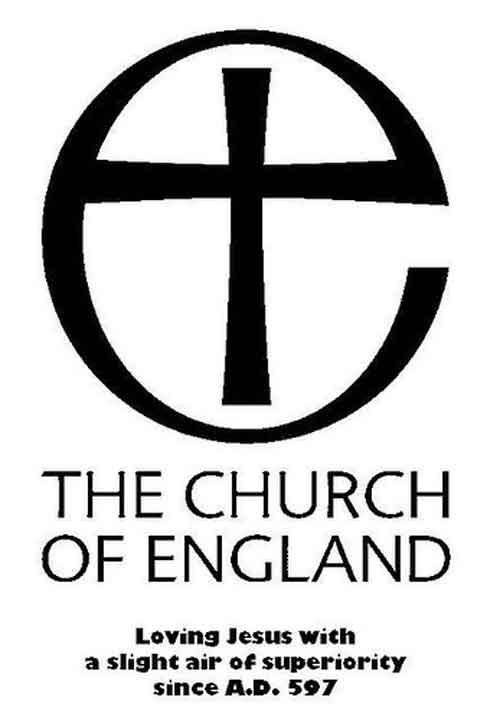
Are we confusing the Church of England (Henry VIII) with the church IN England? I think the logo is wrong.
I do not think that the logo is wrong Dan, because at this moment it is the established state church. However, regardless of the date the church actually became planted in England, I agree with you, before it was the Church of England, it definitely was the Church in England.
So confusing LOL! so following this logic- under Mary was it the Church OF or IN England?
Applause!
Oh, and for the person who said Glastonbury Abbey was in England in 200 — that is an anachronism, not because Gastonbury Abbey wasn’t there – it may well have been. But England wasn’t.
A bit like the song about Columbus:
In 1492 just to see what he could see
Columbus, an Italian, looked out across the sea
He said Isabella, babe, the world is round
And the USA’s just a-waiting to be found.
Prior to being the established state church it was the Church in England/Britian. Whether Catholic and faithful to Rome, or Protestant and free of Rome, once it was the established church it was the Church of England.
So, David, under Mary – reunited with Rome, was it the Church of England or the Church in England? Catholics in NZ will call their church the Church of New Zealand, whilst Anglicans here call it “in New Zealand”. Personally, I think the “of” and “in” are more flexible.
Was it the established church under Mary? If so, then “of”.
Ah, the C in E (or C in B?) seems to date from as far back as 38 A.D. according to http://www.bethelcog.org/church/the-origin-of-our-western-heritage/the-apostles-where-did-they-go … not sure about the historical accuracy of the details – in particular I’m not sure if Gildas wrote about how much of an air of superiority was present then, unfortunately, so we may have to stick with the year 597 🙂
As Steve Hayes implies, irrespective of what you call the English church before Henry, you’ll have a hard job calling something “the Church of England” before Vortigern, just because the English hadn’t arrived yet!
whether or not the Lord visited Britain in the first century, to call the land, England is anachronistic. And it was 17 centuries before “those dark satanic mills” were built 300 miles further north.