
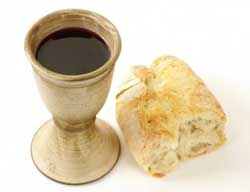
 Divine Liturgy (Greek: θεία λειτουργία, Georgian: საღმრთო ლიტურგია, Bulgarian: Божествена литургия, Russian: Божественная литургия, Armenian: պատարակ, Serbian: Света Литургија, Romanian: Sfânta Liturghie) is the common term for the for the Christian service with bread and wine in the Byzantine tradition. It is used in the Eastern Orthodox and Eastern Catholic Churches. Armenian Christians, both of the Armenian Apostolic Church and of the Armenian Catholic Church, use the same term.
The New Testament uses λατρεία and λειτουργία almost synonymously. λειτουργία occurs more often (Rom 9.4; Acts 24.14; Lk 1.23; Heb 10.11)
The common Hebrew word in the Old Testament for a worship service or rite is עבדה `abodah (Ex 12.25; 13.5). The related verb ‘ābad (to work, to serve) frequently has the sense “to worship,” but the specific verb meaning to perform a rite, especially by ministering at the sanctuary, is more commonly šērēt (Ex 28.35, 43). The Septuagint translates ‘ābōdâ and ‘ābad by λατρεία, “worship” and λατρεύειν, “to worship” (Ex 12.25; Jos 22.27) but also by λειτουργία and even the more general ἔργον, “work” and κάτεργον, “service.”
I do not think “Liturgy” is ever used in the New Testament explicitly for the Christian service with bread and wine, underscoring, once again, our tendency to today more commonly use terms for this service that the New Testament used little or not at all.
The word liturgy is often explained as deriving from “work of the people”. This is an important insight. Originally, of course, it was more the “work for the people”. In the secular context it was the public service of collecting the rubbish, etc. Recovering this second understanding may have real value. When we are participating in the work of the Divine Liturgy, we are doing this work for others…
This is now the fourth in this series. The titles explored in this series so far:
The Lord’s Supper
Holy Communion
The breaking of the bread
And in the middle of the Divine Liturgy the deacon elevates the chalice and paten, with hands crossed, while the priest says, “Thine own of thine own we offer unto Thee, on behalf of all and for all.”
That’s what “liturgy” means — for the people.
Absolutely brilliant! Thanks Steve. [In some of the texts it appears to be the priest that elevates with these words – it doesn’t matter for the brilliant point you are making – but I am interested]. Blessings.
The priest elevates in the absence of a deacon.
The texts that say the priest does it are the ones that take the absence of a deacon for granted. You often hear peiople talking about “the shortage of priests”, but how many times have you heard them talking about “the shortage of deacons”?
That is why I told my bishop, when he wanted to ordain me as a priest, that I would start to begin to be about to commence to think about it on the day that there were two deacons in every parish in the diocese.
Thanks, Steve, very helpful. Blessings.
I’m sorry for commenting this so long after it has been written, but here it is.
I don’t know what the Armenian word «badarak» has to do here, where you are talking about the word «liturgy».
In fact, OLNY BYZANTINE-rite languages use the word «liturgy».
On the contrary, all the other Easterners (Orientals), which no exception, use the word «qurbana» or a translation thereof (Armenian «badarak», English «oblation»).
The traditional term in the West is «mass».
So, here we have three words of equal meaning.
Nevertheless, in countries where the majority is Byzantine, the orther rites use, in vernacular, the word «liturgy». For example, in Greece and Romania, all the rites (including the Roman and the Armenian) use all the terminology of the Byzantine rites, concerning all the services of the Church.
Likewise, in Western countries, all the Easterners (both Byzantine and Oriental) should use, in vernacular, the whole Western liturgical terminology.
This is sometimes the case (Eastern Orthodox in Western countries use words like «vespers», «compline», «prime»), but, unfortunately, they prefer gibberish.
Interesting, Bosco, that in your latest post you have defined ‘liturgy’ as being any activity of worship – whether Eucharistic, or a simple matter of bible-reading together with one other person.
Do you therefore accept that the term ‘Divine Liturgy’ – used mainly by the Orthodox Churches – relates solely to the Celebration of the Eucharist? And would this be because the divinity of Christ is present there, in a
more tangible form? I’m interested in your reply. OR, is there some other reason for use of the word ‘Divine’ ?
Thanks, Fr Ron. I think, to be fair to them, it is not for me, not being Eastern Orthodox (though certainly having a love for them, and delighted to learn from them), to explain their use of the word ‘Divine’ in ‘Divine Liturgy’. I think of the Eucharist as being the jewel in the crown – and the rest of the liturgy as being the crown that supports that jewel. Blessings.